Last post of 2025, yay. ٩(◕‿◕)۶
A reverse proxy like Caddy is handy for automatically generating HTTPS certificates with auto-renewal, but it does have one problem.
endpoint.of.your.s3.domain.tld {
  reverse_proxy garage:3900
}
The scenario
I have a DNS record A *.foo.bar.com so I can add or remove subdomains without touching DNS every time.
I also don’t want to expose every hostname in DNS and make scanning even easier.
Once I set up something like https://whoops.foo.bar.com, I am happy to use the service through the internet.
The weird thing is that, even though I don’t expose A whoops.foo.bar.com as a DNS record,
These bots can find the service almost instantly.
Meet Certificate Transparency
After some rough Googling, one phrase kept popping up in the discussion:
Certificate Transparency
Certificate Transparency is a mechanism for auditing certificate mis-issuance or CA fraud by publishing the record so everyone can audit and verify it.
For each certificate issuance, a CT log entry is appended and made publicly available.
As a result, certificate issuance on your domain becomes public information.
Tools like crt.sh
can easily get the list of entries under your domain.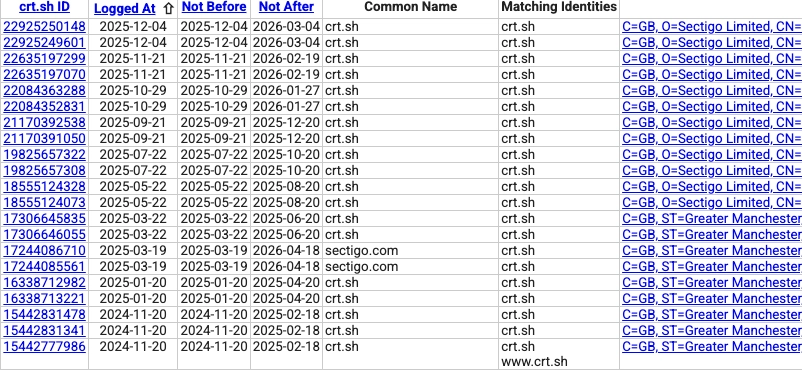
As HTTPS is basically a modern-day requirement, and HTTP-01 is widely adopted as a default challenge (because it only accepts explicit hostnames),
it feels a bit like sending an invitation letter to these bots.
That explains why, even if I don’t create a DNS record explicitly, the bots can still magically find my domain.
The trick they use is watching CT logs. When they find a new certificate, they scan it for vulnerabilities right away.
They don’t even need a DNS scan for this.
The workaround I ended up using
Wildcard Certificate
Instead of explicitly stating the full domain used in the HTTP-01
challenge
used by most automatic certificate setups,
I use the traditional DNS-01
challenge.
It is the only one that can generate wildcard certificates.
My instance uses Pangolin
.
They have a guide
for generating wildcard certs.
Although this method has some problems:
- The DNS provider is required to provide DNS API
- The DNS provider API key is on your proxy, so if that key leaks someone could mess with your DNS
- Wildcard certs are kind of hard to manage if you have more than 1 machine using the cert
- Leak of wildcard cert key is a big problem
But it worked for me. No more bot scanning after the change.
It also has one extra bonus: I don’t have to wait for Let’s Encrypt to generate a cert every time I add something to the domain.
Bots could still see the wildcard certificate I generated, but nothing more.
Yay ٩(◕‿◕)۶.